Opal Identification Guide: Real vs Fake, Natural vs Synthetic
I've spent more time than I'd like to admit staring at opals under a loupe, turning them sideways, holding them up to UV light, and arguing with sellers about whether something is a solid or a doublet. Opals are one of those stones where the difference between a $3,000 gem and a $30 assembled piece can be nearly invisible to an untrained eye — and sellers know it. Whether you're buying your first opal ring, building a collection, or just trying to figure out what grandma's brooch actually is, this guide will walk you through everything I've learned about telling real opals from fakes, understanding the different types, and not getting ripped off.
Table of Contents
- What Makes an Opal an Opal
- The Four Categories: Solid, Synthetic, Doublet, Triplet
- Opal Varieties by Origin and Body Tone
- How to Identify Real Opal: Hands-On Tests
- Advanced Lab and Technical Tests
- Pricing Benchmarks and Market Data for 2025
- Common Scams and Red Flags
- FAQ

What Makes an Opal an Opal
Before we get into identification, you need to understand what's actually happening inside an opal. That mesmerizing flash of color — what gemologists call play-of-color — isn't pigment. It's physics.
Opals are made of tiny silica spheres, roughly 150 to 400 nanometers in diameter, packed together in a matrix with water trapped between them. When white light hits these spheres, it diffracts — splitting into the spectral colors you see dancing across the surface. The size and arrangement of the spheres determine which colors appear. Larger spheres (around 350nm) produce red, the rarest and most valuable play-of-color. Smaller spheres give you blues and greens.
The key word here is irregular. In natural opals, those silica spheres stack in somewhat random arrangements. That's why genuine play-of-color looks unpredictable — patches of fire appear and vanish as you tilt the stone, with irregular boundaries and varying intensities. Remember this. It's your single most important identification clue.
The Four Categories: Solid, Synthetic, Doublet, Triplet
Every opal you'll encounter fits into one of four buckets. Understanding these is non-negotiable if you want to buy intelligently.
Solid Natural Opal
This is the real deal. A single piece of opal, mined from the earth, cut and polished. Nothing added, nothing glued, nothing manufactured. The back might be rough, bumpy, or show the natural host rock (called potch or matrix). When you look at it from the side, you won't see any flat seam lines or distinct layers.
Solid natural opals form over millions of years as silica-rich water seeps into cracks and voids in rock, then slowly evaporates. The process is mind-bogglingly slow — estimates suggest it takes about 5 million years to form a single centimeter of opal.
Synthetic (Lab-Created) Opal
Synthetic opals are real silica-sphere structures, but they're grown in a lab rather than mined. The most well-known process is the Gilson method, developed in the 1970s, which creates opal material by precipitating silica spheres under controlled conditions.
Here's the thing about synthetics: they're too perfect. Because the lab environment is controlled, the silica spheres arrange in unnaturally uniform grids. Under 10x magnification, you'll often see what's described as a "lizard skin" or "snakeskin" pattern — a repeating, columnar structure that natural opals simply don't have. The play-of-color tends to be very regular, almost tile-like.
As of 2025, newer synthetic processes (sometimes called "Gilson 2.0") can even mimic the hydrophane properties of Ethiopian opals — absorbing and releasing water — making them trickier to spot without lab equipment. These sell for around $30 per carat and are eating into about 15% of the budget natural opal market.
Doublet Opal
A doublet is two layers glued together: a thin slice of genuine opal on top, bonded to a dark backing material. The backing is usually black potch (common opal without play-of-color), ironstone, obsidian, or sometimes plain black plastic or glass.
Why do they exist? Economics. A thin slice of quality opal that's too fragile to be a solid gem can be reinforced with a dark backing. The dark layer also intensifies the play-of-color by providing contrast — similar to how a black opal's dark body tone makes colors pop. Doublets aren't inherently dishonest. They're a legitimate product category. The problem is when someone sells a doublet as a solid and charges solid prices.
Triplet Opal
Triplets add a third layer: a clear dome cap (usually quartz crystal or clear glass/plastic) on top of the opal-and-backing sandwich. The opal layer in a triplet is often paper-thin — sometimes less than 0.5mm. You're essentially looking at opal through a magnifying dome.
Triplets are the cheapest assembled opal product. They're fine for fashion jewelry if priced honestly (typically $5–$50), but they should never be confused with or sold as solid opals.
Comparison Table: Opal Types at a Glance
| Feature | Solid Natural | Synthetic | Doublet | Triplet |
|---|---|---|---|---|
| Composition | Single piece of natural opal | Lab-grown silica spheres | Thin opal slice + dark backing + glue | Thin opal + dark backing + clear dome cap |
| Side View | Irregular edges, no seams | Uniform, no seams | Flat, straight glue line visible | Three distinct layers visible |
| Back Surface | Natural, often bumpy/porous | Smooth, uniform | Dark backing (potch, plastic, glass) | Dark, smooth, non-porous |
| Play-of-Color Pattern | Irregular, unpredictable | Uniform, repeating "lizard skin" | Can look natural from top | Magnified/intensified by dome |
| Top Surface | Natural opal surface | Natural-feeling surface | Natural opal surface | Glassy dome, different refraction |
| 2025 Price Range (per carat) | $10–$10,000+ | $5–$50 | $10–$100 | $5–$50 |
| Resale Value | High (5–10x assembled) | Very low | Low–moderate | Very low |
Opal Varieties by Origin and Body Tone
Not all opals are created equal, and where an opal comes from — along with its body tone — dramatically affects its value and the specific identification challenges you'll face.
Australian Opal
Australia produces roughly 95% of the world's gem-quality opal, primarily from three legendary mining regions: Lightning Ridge (New South Wales), Coober Pedy (South Australia), and Queensland's boulder opal fields.
Black opal from Lightning Ridge is the crown jewel of the opal world. It has a dark body tone (rated N1 to N4 on the body tone scale) that provides stunning contrast for the play-of-color. Top-grade Lightning Ridge black opals command $1,000 to $10,000+ per carat in 2025, with exceptional stones going much higher at auction.
White opal (body tone N6–N9) from Coober Pedy is the most common variety. It has a milky, translucent to opaque body with play-of-color that tends to be softer and more pastel than black opal. Prices range from $20 to $200 per carat for good material.
Boulder opal from Queensland is unique — the opal forms in thin veins within ironstone matrix, and it's cut with the host rock still attached as a natural backing. This is not a doublet. The ironstone is part of the natural stone. Boulder opal can be tricky because it superficially resembles a doublet from the side, but the opal-to-ironstone interface will be irregular and natural, not flat and glued.
Ethiopian Opal
Ethiopia's Welo province burst onto the global opal scene around 2008 and has been growing at roughly 15% annually. Ethiopian opals are predominantly the hydrophane variety — they're porous and can absorb water, becoming temporarily transparent when soaked. This is actually a useful identification test (more on that below).
Ethiopian opals offer extraordinary play-of-color at a fraction of Australian prices — typically $50 to $500 per carat for good material. The catch? About 30% of "Ethiopian opals" sold online are actually doublets made from thin Ethiopian opal slices, mislabeled as solids. Ethiopia introduced new export regulations in 2026 requiring holographic certification on stones over 1 carat, which has reduced fakes by an estimated 35%.
One warning about Ethiopian opals: they can crack when they dry out after getting wet, and some are treated with smoke or sugar to darken the body tone (creating so-called "smoked opal"). These treatments aren't always disclosed.
Mexican Fire Opal
Fire opal is a different beast. It has a warm orange-to-red body color and may or may not display play-of-color. Precious fire opal (with play-of-color) from Mexico is highly valued, typically ranging from $50 to $300 per carat. Common fire opal without play-of-color is much cheaper.
Fire opals are frequently imitated by colored glass, resin, and synthetic materials. The body color alone doesn't make it valuable — it's the combination of that fiery body tone with genuine play-of-color that commands premium prices.
Crystal Opal
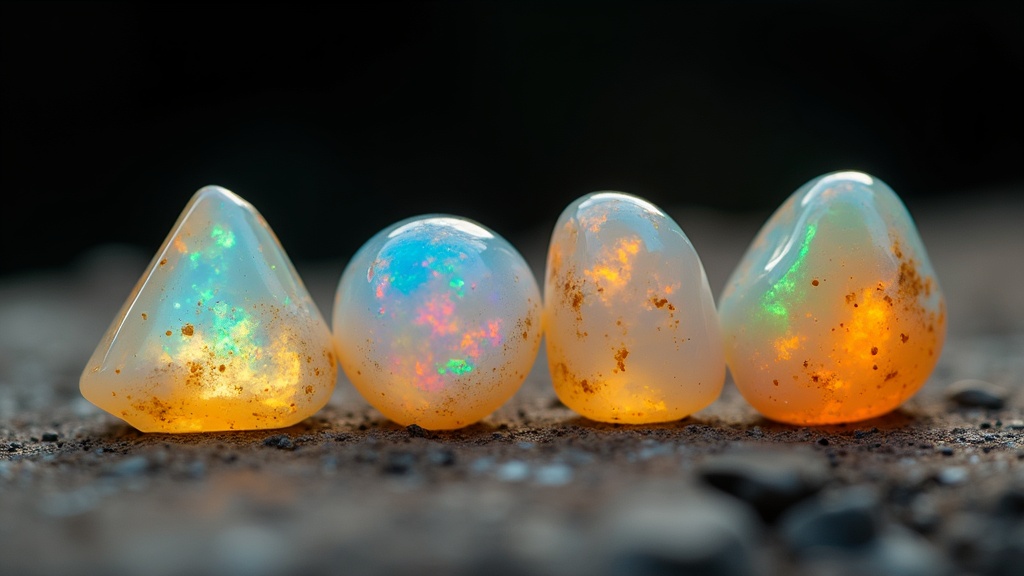
Crystal opal is transparent to semi-transparent, allowing you to see into and sometimes through the stone. It can come from Australia or Ethiopia and is prized for its three-dimensional play-of-color. Crystal opals can be any body tone — a transparent opal with a dark body tone is called a "black crystal opal" and can be extremely valuable.
How to Identify Real Opal: Hands-On Tests
Here's where we get practical. These are the tests you can do yourself with minimal equipment — some need nothing more than your eyes and a well-lit room.
Test 1: The Side Profile Check
This is the single most important test for distinguishing solids from assembled stones. Hold the opal at eye level and look at its edge profile.
- Solid: The side will look like one continuous material. The back may be bumpy, curved, or irregular. No flat seam line.
- Doublet: You'll see a distinct flat line where the opal meets the backing. It's often visible as a thin dark line or a slight color change. The junction is unnaturally straight.
- Triplet: Three layers visible. The top cap (clear dome) sits above the opal, which sits above the dark base. Sometimes you can even see through the cap from the side.
If the opal is already set in jewelry, this test gets harder. Bezel settings in particular can hide the edges completely — and that's sometimes intentional. If a seller refuses to show you an unset stone or one with prong settings that reveal the profile, be cautious.
Test 2: The Back Examination
Flip the stone over.
- Solid natural opal: The back is often rough, porous, and irregular. Australian solids may show traces of the host rock or sandy texture. You might see potch (colorless opal) or matrix.
- Doublet: The back will be the backing material — flat black potch, ironstone, or suspiciously smooth black plastic/glass. If it's plastic, it'll feel lighter than you'd expect.
- Triplet: Similar to doublet but the backing is often completely flat and machine-smooth.
- Synthetic: Uniformly smooth and consistent. No natural irregularities.
Test 3: The Pattern Analysis
Look at the play-of-color from the top, tilting the stone slowly under a good light source.
- Natural opal: The color pattern should be irregular and organic. Colors appear in random-shaped patches, flashes, or pinfire patterns. No two areas look identical.
- Synthetic opal: The pattern repeats. Under 10x magnification, you'll see organized columns of color arranged in a grid-like formation. The "lizard skin" or "chicken wire" pattern is the giveaway.
Natural pattern (conceptual):
 ╔══╗  ╔═╗
 ║▓▓║╔═╝░║
 ║▓▓╚╝░░░║   <- Irregular, organic patches
 ╚══╗░░╔═╝
    ╚══╝

Synthetic pattern (conceptual):
 ┌──┬──┬──┐
 │░░│▓▓│░░│
 ├──┼──┼──┤   <- Regular, repeating grid
 │▓▓│░░│▓▓│
 └──┴──┴──┘
Test 4: The Water Test (Ethiopian Opals)
This only works for hydrophane opals, which are mostly Ethiopian. Place the stone in water for a few minutes. A genuine Ethiopian hydrophane opal will slowly become more transparent as it absorbs water. A synthetic or glass imitation won't change at all.
Important caveat: newer synthetic opals (the 2025 Gilson 2.0 variants) can mimic this hydrophane behavior. So a positive water test doesn't guarantee natural origin — but a negative one on a supposed Ethiopian opal is a red flag.
Test 5: The Touch and Weight Test
Natural opal has a specific gravity of 2.0–2.2 g/cm³. Glass imitations tend to feel heavier. Plastic imitations feel lighter and warmer to the touch (opal should feel cool when you first pick it up, like any stone).
Resin and plastic fakes also tend to have a slightly "sticky" feel compared to natural opal's smooth, glassy surface.
Test 6: The Light Behind Test
Hold the opal up so light passes through it from behind (use your phone flashlight). In a genuine opal, you may see light diffuse through naturally, especially in crystal or white opals. In a triplet, the dome cap may show differently than the opal body — you might see the outline of the thin opal slice sandwiched between the layers.
For doublets, the backing will block all light from behind, creating a sharp cutoff between the light-passing opal layer and the opaque back.
Advanced Lab and Technical Tests
If you're spending serious money, hands-on tests aren't enough. Here's what the pros use.
Microscopy (10x–40x Magnification)
Under a gemological microscope, natural opal shows irregular silica sphere arrangements, natural inclusions, and organic growth patterns. Synthetic opal shows the telltale columnar structure and uniform sphere packing. This is probably the most reliable non-destructive test available.
Refractive Index
Natural opal: 1.37–1.47 (varies by water content and type). Synthetics tend to cluster tightly around 1.45. A refractometer reading can narrow things down, though it's not definitive on its own.
UV Fluorescence
Under long-wave UV light, natural and synthetic opals fluoresce differently. More useful: UV light can reveal the glue layers in doublets and triplets, which often fluoresce a different color than the opal itself. If you see a distinct fluorescent line at the junction, it's assembled.
Raman Spectroscopy
This is the gold standard for definitive identification. It measures the molecular vibration patterns of the silica structure. Natural and synthetic opals have subtly different spectra. Australian labs now use upgraded Raman spectroscopy to distinguish Ethiopian natural opals from the new hydrophane synthetics.
AI-Powered Authentication
In 2025, GemsMakers launched a free online 3D opal scanner that uses photogrammetry to detect layer thickness in assembled opals, claiming 99% accuracy on triplets. About 50% of Australian opal exporters have reportedly adopted this tool. It's not a replacement for physical lab testing, but it's a useful first-pass filter, especially for online purchases.
Pricing Benchmarks and Market Data for 2025
Numbers don't lie, and knowing what things should cost is one of your best defenses against getting scammed.
| Opal Type | Origin | Body Tone | 2025 Avg. Price/Carat | Trend |
|---|---|---|---|---|
| Black Opal (solid) | Australia (Lightning Ridge) | N1–N4 | $2,500 | Up 12% from 2024 (supply shortages) |
| White Opal (solid) | Australia (Coober Pedy) | N6–N9 | $50–$200 | Stable |
| Boulder Opal (solid) | Australia (Queensland) | Varies | $100–$1,000 | Stable to rising |
| Crystal Opal (solid) | Australia/Ethiopia | N7+ transparent | $100–$2,000 | Rising |
| Ethiopian Welo (solid) | Ethiopia | Varies | $150 | Stable |
| Fire Opal (precious) | Mexico | Orange-red | $50–$300 | Stable |
| Doublet | Any (assembled) | Dark (from backing) | $10–$100 | Declining |
| Triplet | Any (assembled) | Dark (from backing) | $5–$50 ($15 avg.) | Declining (crackdown on mislabeling) |
| Synthetic | Lab | Varies | $5–$50 ($20 avg.) | Stable |
A few key market facts to keep in mind:
- Australia still produces about 95% of gem-quality opal globally (1–2 million carats annually)
- Ethiopia's output is growing 15% year-over-year and now accounts for 5–10% of the market
- GIA or IGS certification adds a 20–50% price premium on natural solids
- Certified natural solids hold 5–10x the resale value of assembled opals
- The Australian Opal Association launched blockchain-based traceability for solids in 2026, boosting premiums by approximately 18%
Common Scams and Red Flags
Let me be blunt about what's happening out there. An estimated 40–60% of opal jewelry sold online consists of doublets or triplets being passed off as solid opals. Synthetics make up about 20% of "bargain" opals sold under $20 per carat. Here are the biggest red flags:
"Too good to be true" pricing. If someone is offering a vivid black opal for $50, it's almost certainly a doublet, triplet, or synthetic. Full stop.
Bezel-set stones with no side views. Bezel settings hide edges perfectly. If a seller only shows top-down photos and the stone is bezel-set, ask for profile shots. If they can't or won't provide them, walk away.
Vague origin claims. "Australian-type opal" or "opal-like gemstone" are weasel phrases. Demand specifics: mine location, solid/doublet/triplet, treated or untreated.
Etsy and Amazon marketplace listings. Roughly 70% of opal listings on major marketplaces contain inaccurate descriptions, according to industry estimates. This doesn't mean you can't find legitimate sellers there — but your guard needs to be way up.
"Smoked" Ethiopian opal sold as black opal. Smoke treatment darkens Ethiopian opal's body tone to mimic expensive Australian black opal. It's technically still natural opal, but the treatment should be disclosed and it's worth a fraction of untreated Australian black.
No certification on expensive purchases. For any opal over $500, insist on independent certification from GIA, IGS, or a reputable gemological lab. The $100 lab fee is insurance against thousands in potential losses.
FAQ
How can I tell if my opal is real or fake without any special equipment? The most reliable no-equipment test is the side profile check. Hold the opal at eye level and examine its edges. A genuine solid opal will show one continuous material with natural irregularities on the back. Doublets show a flat, straight glue line where the opal meets its backing. Triplets show three distinct layers. Also check the play-of-color — natural opals have irregular, organic-looking color patterns, while synthetics show suspiciously uniform, repeating patterns.
What is the difference between a doublet and a triplet opal? A doublet has two layers: a thin slice of genuine opal glued to a dark backing material like black potch, ironstone, or plastic. A triplet adds a third layer — a clear dome cap of quartz or glass on top. Triplets use an even thinner opal slice (often under 0.5mm) than doublets. Both are legitimate products when properly disclosed, but triplets are the cheapest category and should never be sold at solid opal prices.
Are Ethiopian opals as valuable as Australian opals? Generally no, though exceptional Ethiopian specimens can be quite valuable. Australian black opals from Lightning Ridge average around $2,500 per carat in 2025, while Ethiopian Welo opals average about $150 per carat. The price difference reflects rarity, historical prestige, and stability — Ethiopian hydrophane opals absorb water and can be less stable over time. That said, Ethiopian opals offer incredible beauty at more accessible price points and the market is growing rapidly.
Can synthetic opals pass as natural to the naked eye? Yes, especially to untrained eyes. Modern synthetics can look very convincing from the top. However, under 10x magnification, synthetic opals almost always reveal their telltale "lizard skin" or columnar pattern from the uniform silica sphere arrangement. The 2025-generation synthetics that mimic Ethiopian hydrophane properties are particularly deceptive and may require Raman spectroscopy for definitive identification.
Is boulder opal the same as a doublet? No, and this is a common confusion. Boulder opal from Queensland, Australia, naturally forms in thin seams within ironstone. When it's cut, the ironstone remains as a natural backing. The key difference is that the opal-to-ironstone boundary in boulder opal is natural and irregular, while a doublet's glue line is flat and artificial. Boulder opal is a solid natural opal and is valued accordingly.
How much should I expect to pay for a genuine solid opal? It varies enormously by type. Entry-level white Australian opal starts around $20 per carat. Good Ethiopian solids run $50–$500 per carat. Quality Australian black opals start at $1,000 per carat and can exceed $10,000 for exceptional specimens. If you're seeing vivid opals priced under $20 per carat, especially online, you're almost certainly looking at synthetics, doublets, or triplets regardless of what the listing claims.
What certification should I look for when buying expensive opals? For purchases over $500, look for independent certification from GIA (Gemological Institute of America), IGS (International Gem Society), or a reputable regional gemological laboratory. The report should specify whether the opal is natural or synthetic, solid or assembled, treated or untreated, and its geographic origin. Certified natural solids command a 20–50% premium over uncertified stones, which more than offsets the certification cost for valuable pieces.
Do opals need special care to prevent damage? Yes. Opals contain 3–21% water and are relatively soft (5.5–6.5 on the Mohs scale). Avoid extreme heat, rapid temperature changes, harsh chemicals, and ultrasonic cleaners. Ethiopian hydrophane opals need extra care — prolonged water exposure can cause temporary transparency changes and repeated wet-dry cycles may eventually cause crazing (fine surface cracks). Store opals in a slightly humid environment rather than bone-dry safes. Doublets and triplets are especially vulnerable because water and chemicals can dissolve the adhesive layers over time, causing delamination.